6. Report and make reproducible
The last step is writing it up so a reader can evaluate your analysis and a replicator can rerun it.
Methods section
A complete methods section covers the corpus, the preprocessing, the model and
K, the covariate specification, and the validation. A template:
We used [LDA / STM / …] to identify latent topics in a corpus of N documents drawn from [population], covering [time span]. The unit of analysis is the [article / paragraph / speech]; long documents were segmented into chunks of ≤ W words. After preprocessing (lowercasing, removing punctuation and a [SMART + custom] stopword list, pruning terms in fewer than a documents or more than b% of documents, and detecting collocations), the vocabulary contained M terms and T tokens.
We estimated models with K = [value] topics. [Rationale: theory + a
searchKscan over K ∈ {…}, balancing semantic coherence, exclusivity, and interpretability; results were robust to K ∈ {…}.] For the STM, topic prevalence was modeled as a function of [covariates]. We fixed the random seed (seed = …) for reproducibility.We validated the topics with word- and document-intrusion tests ([accuracy / agreement]), per-topic coherence and exclusivity, and bootstrap stability across B resamples; [k] topics flagged as unstable are interpreted cautiously. Software: topica [version].
Results section
- A topic table: each topic's label, its top probability and FREX words, and its overall prevalence.
- Covariate effects with (clustered) standard errors and intervals.
- Representative quotes for the topics you interpret: close reading, not just word lists.
import pandas as pd
import topica

labels = topica.inspect.label_topics(model.topic_word, model.vocabulary, n=7)
prevalence = model.doc_topic.mean(axis=0)
table = pd.DataFrame({
    "topic": range(model.num_topics),
    "prevalence": prevalence,
    "top_words_frex": [", ".join(w for w, _ in labels[t]["frex"])
                       for t in range(model.num_topics)],
})
table.to_csv("topic_table.csv", index=False)
For an at-a-glance figure of the whole model, topica.plot_report composes the
diagnostics into one matplotlib Figure you can save straight to a publication
or supplement. Panels are adaptive: topic prevalence (with each topic's top
words) and the coherence-vs-exclusivity quality plot are always drawn, and the
topic-correlation heatmap, topics over time, and prevalence by class appear when
you pass texts, timestamps, or groups.
fig = topica.plot_report(model, texts=texts, timestamps=year, groups=party)
fig.savefig("model_report.png", dpi=200)   # or .pdf
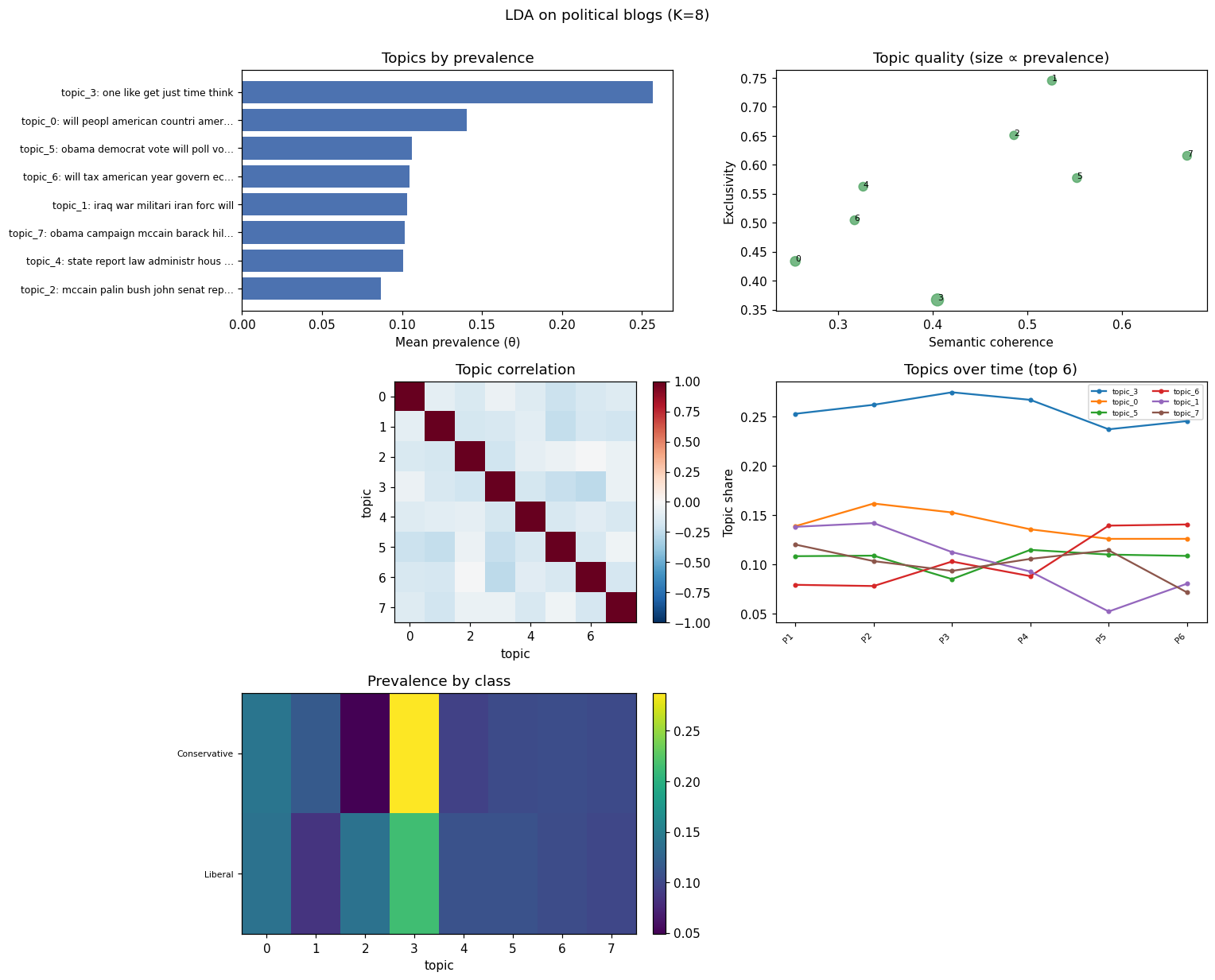
The example above is reproducible with python examples/plot_report_example.py.
Supplementary materials
Put in the appendix / replication archive:
- The full topic–word distributions and the document–topic matrix.
- Robustness to K (the headline result at neighboring
K). - Preprocessing details and the exact stopword list.
- Validation results (intrusion accuracy, coherence/exclusivity per topic, stability scores).
import numpy as np
np.savetxt("phi.csv", model.topic_word, delimiter=",")   # topics × words
np.savetxt("theta.csv", model.doc_topic, delimiter=",")  # docs × topics
model.save("model.tt")                                    # full state, reloadable
Make the pipeline reproducible
- Fix every seed. topica fits are bit-for-bit deterministic for a given
seed, across machines and core counts. State the seeds you used. - Script the whole pipeline end to end, from raw text → preprocessing → fit → tables/figures, so it runs from one command.
- Pin versions. Record the topica and NumPy versions
(
topica.__version__). - Share the model.
model.save(path)writes the complete fitted state;Model.load(path)brings it back, so reviewers can reproduce every number without refitting. - Record the analysis, not just the model.
topica.provenance.record_fit(model, corpus,
  ...)
writes an analysis manifest: a small, privacy-aware JSON record of the fit's inputs, settings, environment, and your interpretive decisions, plus fingerprints that letrecord.verify(corpus, model)report later whether the same corpus and model still reproduce it. It records fingerprints and coarse counts, not raw text, and defaults to the most private setting.
You're done
A corpus you can defend, a K you can justify, topics you've validated,
effects with well-calibrated uncertainty, and a pipeline anyone can rerun. That is a
topic-modeling analysis a social-science journal can publish.
See the worked examples for this workflow applied end to end on real data.